Exhibition · National Gallery of Ireland · Through 7 February 2027.
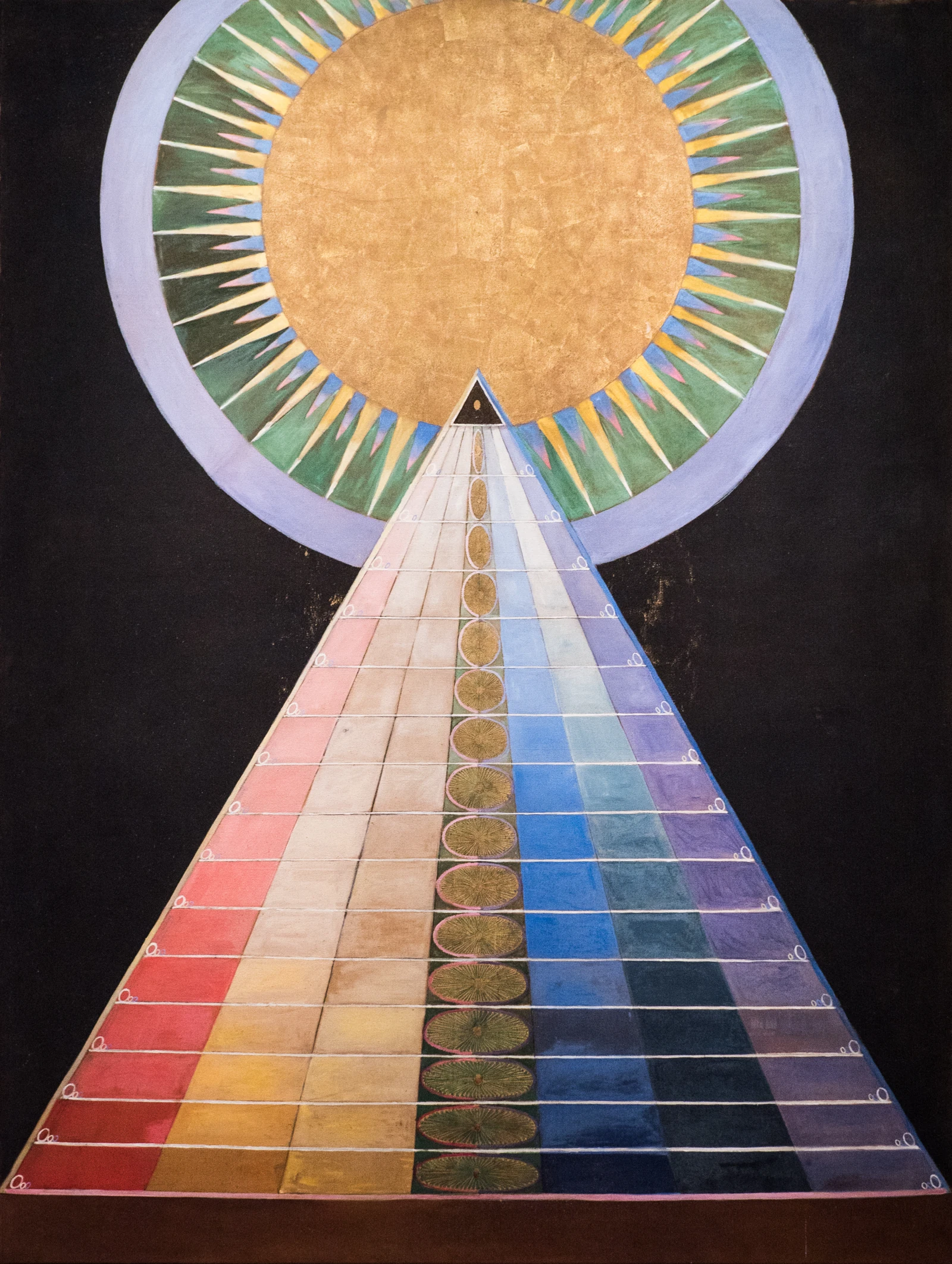
A triangle rises towards a golden disc. The image has the clarity of a sign, yet it also suggests movement: an approach, an ascent, a destination. Hilma af Klint’s Altarpiece, Group X, No. 1, from 1915, is among the works in Artist and Visionary at the National Gallery of Ireland. The exhibition runs from 15 October 2026 to 7 February 2027. 1
Developed with the Hilma af Klint Foundation and curated by Janet McLean, the show is Ireland’s first major exhibition devoted to the artist. Paintings, drawings and watercolours bring her abstract practice into contact with the studies of plants, portraits and landscapes that also occupied her. The museum’s selection gives viewers several routes into the work, rather than a single account of its origin. 2
The November programme adds another layer of interpretation. The Gallery has announced a talk by biographer Julia Voss on 19 November, addressing af Klint’s life and afterlife. That subject is particularly relevant to an artist whose public recognition developed long after the paintings themselves were made. 2
Af Klint imagined a specific architectural setting for her spiritual work. The Guggenheim’s account of The Paintings for the Temple describes a proposed spiral building that was never constructed. Produced between 1906 and 1915, the series joined biomorphic and geometric forms with changes of scale and colour. Painting and the imagined journey through a building belonged to the same undertaking. 3
The spatial implication is worth lingering over. A painting conceived as part of a sequence asks a viewer to remember what came before it. A circle can register as an end point; a triangle can establish direction. These are editorial readings of the image’s organisation, rather than a claim that its symbols carry a single, settled meaning.
The Dublin exhibition’s inclusion of recognisable subjects offers a productive counterpoint to the abstraction. Looking at a plant study and a geometric painting within the same project encourages attention to observation, repetition and structure. It becomes possible to consider how an artist might move between the visible world and a system intended to describe what remains unseen.
For a design audience, that movement has a practical resonance. Rooms are also understood through sequence, orientation and the relationships between their parts. Af Klint’s imagined destination turns the encounter with an image into a question about arrival: how does a work prepare us to see what follows?