Housing study · La Borda, Barcelona · Completed 2018.
A home is shaped by more than the boundary of its private rooms. The arrangements for ownership, maintenance and shared decision-making influence what a building can provide over time. At La Borda in Barcelona, these questions were part of the architectural brief from the beginning, giving a completed housing project continuing relevance to the discussion of residential value.
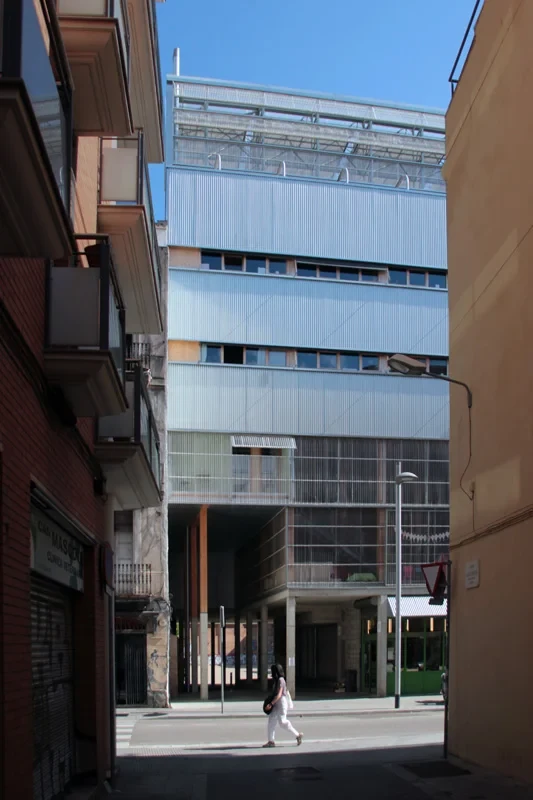
Designed by Lacol and completed in 2018, La Borda contains twenty-eight homes alongside communal facilities. The initiative emerged in 2012 from the neighbourhood’s recovery of the former Can Batlló industrial site. Barcelona City Council provided the site through a seventy-five-year arrangement, allowing a resident-led cooperative to develop a particular model of access to housing. 1
The cooperative describes its ambition in terms of decent, affordable, environmentally responsible housing and a non-speculative structure centred on inhabitants. It also connects everyday life to feminist economics, mutual support and the social and solidarity economy. Those stated principles give the project a framework against which its physical spaces can be read. 2
Lacol’s programme combines homes in three sizes with a shared kitchen and dining room, laundry, guest accommodation, multipurpose space, care space and outdoor areas. A central courtyard organises the building. Residents participated through workshops on the collective brief, environmental strategies and dwelling types, linking decisions about space to the people expected to use it. 1
The editorial distinction is between a shared amenity and a shared responsibility. A communal room acquires value through agreements about access, cleaning, cost and the kinds of activity it can support. Its presence on a plan is the beginning of that process. The governance around it helps determine whether it becomes useful in everyday life.
The courtyard can also be understood at two scales. It provides an architectural centre, making the building legible, while placing journeys between private and collective rooms within a common spatial field. That arrangement creates opportunities for contact. The quality of a cooperative model still depends on preserving choice and privacy alongside those opportunities.
La Borda is therefore useful as a precise case study rather than a universal formula. Its municipal land arrangement, resident organisation and architectural programme belong to one particular context. What travels is a method: establish the intended form of living, connect it to a workable structure of tenure, and let those commitments influence the rooms, thresholds and shared resources that are built.